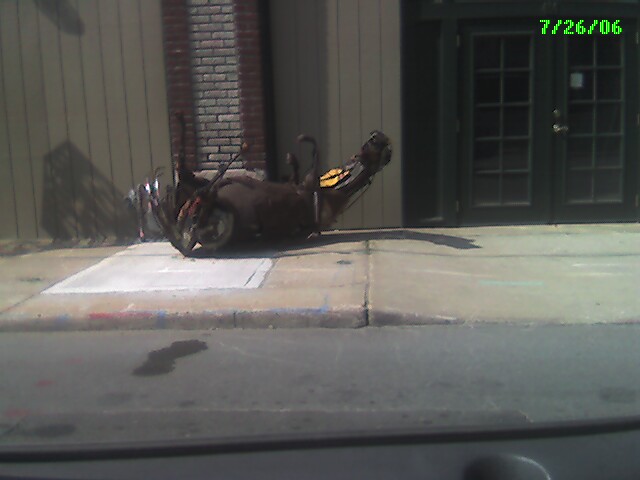
 On A Roll
To roll around
as though round were
a continuum
as though it were sound
policy to engage in
such activity
could be the folly
of unbridled youth
in the midst of urban design
or it could just be the
unsteadiness that comes
with age.
On A RollA few poetry related items this morning:
 Starting today I am beginning a weekly series to introduce a new poet each week. Some of these poets will have a national stature and some will be lesser knowns, perhaps poets with more regional ties. My intent is a mixture of both. If you have someone you'd like me to consider, please feel free to drop me a line.
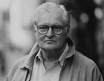 Deborah over at 32 Poems posed this question recently... "Would you be satisfied if you knew your book was published simply because the judge knew you? Or would you be happy just to get the book published?" The question was an outgrowth of a story about the publication of John Ashbery's first book. Deborah nod not answer her own question and I'm not going to either. Not here in this post, anyway. That is not the point of my blog for today. If you don't know the story, a somewhat more detailed account of it then Deborah provided can be found in an April 2006 article by Andrew Varnon on the 50th anniversary of the publication of Some Trees, Ashbery's first book.[here].
It is safe to say that in the past half century, John Ashbery has left a preemenent mark upon American Poetry and may well be viewed by many as a "poster child" of experimental and avant garde poetry.
So as the story goes, Ashbery's first book was almost not the beginning of this long rise in prominence. The manuscript that became Some Trees was first rejected by the poet W.H. Auden who was judging the work submitted. It seems that Auden was unhappy with all the entries but because of a mutual friend, Auden asked for the manuscript again and published it. Years later, another mutual friend told Ashbery that Auden," had never been able to understand a line of his poetry."
Varnon recounts talking to poet David Lehman who says, "Ashbery is the single poet about whom most people have opinions." My own experience is that Lehman is likely correct. At least to the extent that people have any knowledge of him and his work. Last year I circulated a wonderful article about Ashbery that appeared in the New Yorker to many of my writing friends. For some it was their first introduction to him. It was amazing the strong opinions and debate then ensued about what constitutes art as a result of this article.
I myself have enjoyed Ashbery's work that I have read. I have said here many times before, while there are many poets who write accessible work that I enjoy, I am disappointed in those who insist that this is the yardstick by which literary art must be measured.
There was something in Varnon's article that struck me as interesting and gave me pause for thought. It was how Meghan O'Rourke writing for Slate has described Ashbery's poetry as, "a kind of radio transistor through which many different voices, genres, and curious archaeological remains of language filter, so that the poems are like the sound you would hear if you spun through the FM/AM dial without stopping to tune into any one program for long." It has occurred to me that as an adult with ADD perhaps it is this very dynamic that makes Ashbery's poetic voice such a comfort to my own ears and provides a uniquely appealing language dynamic for me. It is just a thought, but have to wonder if this were also the case with others who have ADD?
Tags: John Ashbery ADD ADHD literary art poetry

